Copyright © 2026 Dairy Farmers of Canada. All rights reserved.

Are you in GeoProvince?

Your IP address says that you are in GeoProvince. This page is meant for residents of SiteProvince. We recommend you use GeoTitle instead.
Go to GeoTitle I wish to remain on SiteTitle
Curriculum connections

This activity supports:

Alberta’s Physical Education, Health and Wellness curriculum for grades 4, 5, and 6.  

  Grade 

  Organizing Idea 

  Learning Outcome 

  PEW 4  

  Healthy Eating  

Students examine nutrition and explain how it informs decision making about food.  

  PEW 5  

  Healthy Eating  

Students evaluate aspects of nutrition and examine their benefits to well-being.  

  PEW 6  

  Healthy Eating  

Students examine access to food and its effect on making decisions related to nutrition.  


Saskatchewan’s Health Education learning outcomes for grades 4 and 5

  Subject/ grade 

  Learning outcome

Health Education 4  

Assess what healthy eating and physical activity mean for pre/adolescence.  

Health Education 5  

Analyze personal eating practices.  


And more!

✍🏽Having students reflect through discussion, a journal entry, or exit slip can help reinforce key outcomes, especially those highlighted in the English Language Arts curriculum. 


Manitoba's Physical Education/ Health Education - coming soon

Try these classroom discussion questions! 

Classroom discussion questions:  

  • How did you decide on foods to complete the meals?Note: answers can focus on personal, family, community, and cultural factors such as time, preferences, cultural food practices, access to food, and food skills. For example, completing the meal with foods you like to eat can support both physical and mental well-being. 
  • How could you adapt one of these meals for a friend who is vegetarian or has another food restriction? For example, completing “meal 1” with a protein food like lentils or cheese. If your friend doesn’t eat fish, you could swap out tuna in “meal 3” for egg or mashed chickpeas. 
  • What could you do to reduce the cost of this meal? For example, use frozen, canned, or seasonal foods to complete the meal.  
  • How does eating different types of food help our body? Consider how eating different foods helps children get the nutrition their growing bodies and minds need to play, learn, move, and feel good. 


✨ This curriculum connection guide was developed in collaboration with a curriculum consultant. The activity can support a wide range of learning outcomes across K–12. We invite you to adapt them based on your students’ needs – no one knows your learners better than you. ✨ 


Why assess example meals rather than student food records? 

💛 Students have reported that it can be stressful to track and be graded on the foods they eat, especially when they may have little control over what foods are available in the home. Applying learning to general rather than personal examples creates safety for learners in this activity. 

Research has started to connect food tracking activities with weight preoccupation and disordered eating behaviours in vulnerable adolescents. Our team is committed to creating resources that enhance learning without unintended negative impacts on mental health. 


*Pinhas et al. Trading health for a healthy weight: the uncharted side of healthy weights initiatives. Eat Disord 2013;21:109-116. 

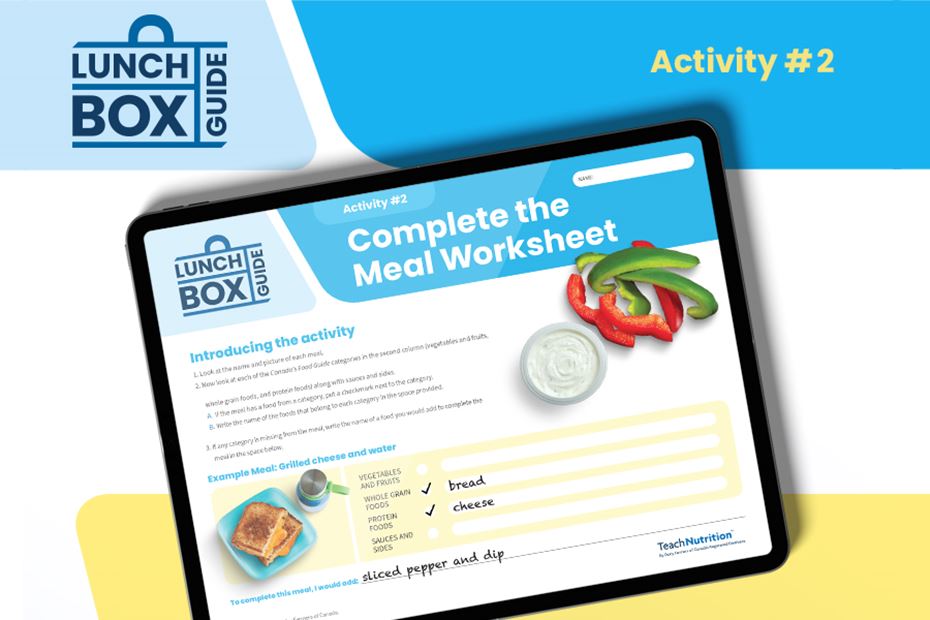
Lunch Box Guide Activity #2: Complete the Meal

You may also like

Grades K to 3

Grades 4 to 6

Grades 7 to 9

Grades 10 to 12

Canada’s Food Guide in Action Videos

Canada’s Food Guide (CFG) is made up of many different components. One such component, and[...]
Learn More
Learn More

Grades K to 3

Grades 4 to 6

Food Bingo

This unique bingo game is fun, yet educational. It explores foods grown and produced in Ca[...]
Learn More

All Levels

Classroom Kitchen

Looking for fun recipes to make at your school or child care facility? 


Try our recipe[...]
Learn More

Early Learning

Grades K to 3

Grades 4 to 6

School Lunch Tips

Looking for lunch ideas for school? Our Registered Dietitians are here to help! 

Whether y[...]
Learn More

Grades K to 3

Grades 4 to 6

Grades 7 to 9

Grades 10 to 12

Let's Talk About Food in Schools: Handout

Need some guidance on how to approach conversations around food and eating with students?[...]
Learn More

Early Learning

Grades K to 3

A Guide to Cooking Techniques

This resource provides descriptions and visual demonstrations for techniques such as measu[...]
Learn More
Learn More

Grades K to 3

Food Explorers - Alberta & Saskatchewan

This Food Explorer Kit is designed for Alberta and Saskatchewan educators. Order your kit[...]
Learn More
Learn More

Grades K to 3

Grades 4 to 6

Mealtime Roles in Elementary School Poster

Support students in learning to eat well and help everyone relax and enjoy meals and snack[...]
Learn More