Copyright © 2026 Dairy Farmers of Canada. All rights reserved.

Are you in GeoProvince?

Your IP address says that you are in GeoProvince. This page is meant for residents of SiteProvince. We recommend you use GeoTitle instead.
Go to GeoTitle I wish to remain on SiteTitle
Curriculum connections

This activity supports:

Alberta’s Physical Education, Health and Wellness curriculum for grades 1, 2, and 3.  

  Grade 

  Organizing Idea 

  Learning Outcome 

  PEW 1  

  Healthy Eating  

Students examine and connect a variety of foods to growth and development.  

  PEW 2 

  Healthy Eating  

Students examine internal and external factors that influence food choices and decisions.  

  PEW 3 

  Healthy Eating  

Students investigate food and describe how it affects the body.  


Saskatchewan’s Health Education learning outcomes for grades 1, 2, and 3

  Subject/ grade 

  Learning outcome

Health Education 1  

Examine healthy behaviours and opportunities and begin to determine how these behaviours and opportunities may affect personal well-being.  

Health Education 2  

Determine how healthy snacking practices influence personal health.  

Health Education 3  

Determine the role of a variety of healthy foods and physical activity on the health and development of the mind, body, and immune system.  


And more!

  • ✍🏽 Inviting students to discuss or write a short reflection – such as a learning journal entry or on an exit slip – can support their growth in areas related to English Language Arts
  • 📊 To connect to Mathematics, survey the class for food or snack preferences. Graph results using concrete graphs or pictographs and ask questions related to the data. 

Try these classroom discussion questions! 

Classroom discussion questions: 

  • How does food help our body? Consider how eating different foods helps children get the nutrition their growing bodies and minds need to play, learn, move, and feel good.  
  • How did you decide which foods to choose for your Lunch Box Guide? How were your food choices similar to and different from your classmates? Note: preferences, experiences, and needs (such as food allergies) all impact our food choices. Use this opportunity to learn more about students’ favourite foods. For example, what type of berries, bread, cheese, beans, or cookies do they like to eat? What ways do they eat these foods with their families or caregivers? You may find that while some students enjoy the same foods, they eat them in different ways.  
  • How can preparing a food differently change the taste, texture, colour, or appearance of the food? E.g., apples can be enjoyed fresh, dried (apple chips), baked, shredded, blended (apple sauce), etc. 


✨ Our team worked with a curriculum consultant to support these curriculum alignments. There are many ways to connect the activity to the curriculum from K–12. You know your learners best, so feel free to meet them where they are. ✨ 

How do you talk about foods not pictured in the Food Guide? 

💛 Making space for a variety of foods contributes to a positive relationship with food and recognizes that factors such as taste, culture, and food traditions play a role in students’ food choices.

As students share examples of foods they like to eat, welcome those that come from the “sauces and sides” section in addition to foods from Canada’s Food Guide. The sauces and sides section was created to highlight foods from beyond Canada’s Food Guide. Foods that do not fit neatly into the categories in the Food Guide are sometimes misrepresented as unessential or “junk” food, but all foods have a role. For example, what would curry be without turmeric or chilies? Salad without salad dressing? And a chewy cookie can add flavour and texture to a meal. None of these ingredients or foods belong to a category, yet they all have value. 


👉 Not sure how to approach food conversations with students? Let’s Talk About Food offers practical tips to help you feel more confident and supported.  

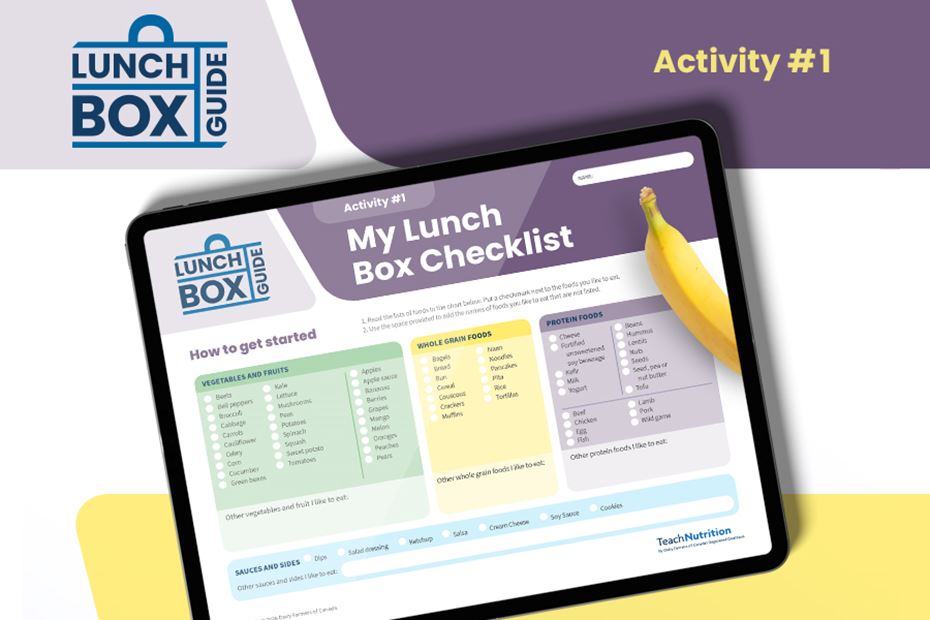
Lunch Box Guide Activity #1: My Lunch Box Guide

You may also like

Grades K to 3

Grades 4 to 6

Grades 7 to 9

Grades 10 to 12

Canada’s Food Guide in Action Videos

Canada’s Food Guide (CFG) is made up of many different components. One such component, and[...]
Learn More
Learn More

Grades K to 3

Grades 4 to 6

Food Bingo

This unique bingo game is fun, yet educational. It explores foods grown and produced in Ca[...]
Learn More

All Levels

Classroom Kitchen

Looking for fun recipes to make at your school or child care facility? 


Try our recipe[...]
Learn More

Early Learning

Grades K to 3

Grades 4 to 6

School Lunch Tips

Looking for lunch ideas for school? Our Registered Dietitians are here to help! 

Whether y[...]
Learn More

Grades K to 3

Grades 4 to 6

Grades 7 to 9

Grades 10 to 12

Let's Talk About Food in Schools: Handout

Need some guidance on how to approach conversations around food and eating with students?[...]
Learn More

Early Learning

Grades K to 3

A Guide to Cooking Techniques

This resource provides descriptions and visual demonstrations for techniques such as measu[...]
Learn More
Learn More

Grades K to 3

Food Explorers - Alberta & Saskatchewan

This Food Explorer Kit is designed for Alberta and Saskatchewan educators. Order your kit[...]
Learn More
Learn More

Grades K to 3

Grades 4 to 6

Mealtime Roles in Elementary School Poster

Support students in learning to eat well and help everyone relax and enjoy meals and snack[...]
Learn More