
Copyright © 2026 Dairy Farmers of Canada. All rights reserved.

Are you in GeoProvince?

Your IP address says that you are in GeoProvince. This page is meant for residents of SiteProvince. We recommend you use GeoTitle instead.
Go to GeoTitle I wish to remain on SiteTitle

Teaching nutrition

November 01, 2022

Early Learning

Grades K to 3

Grades 4 to 6

Grades 7 to 9

Grades 10 to 12

How to Teach Canada’s Food Guide

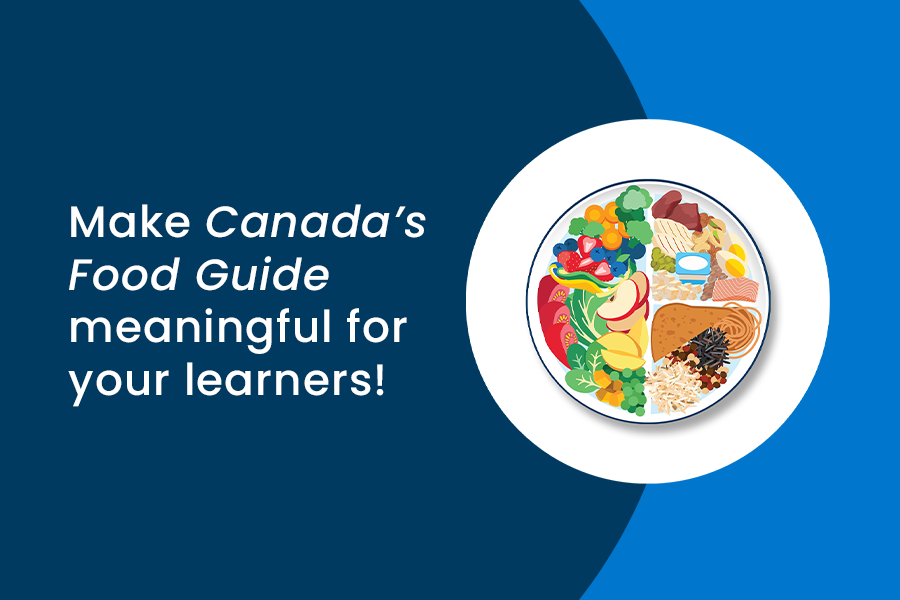
Learn how to make Canada’s Food Guide meaningful for your learners. This article includes age-specific activities you can use in early learning and at school!

star

Highlights

  • Pacing learning in nutrition education
  • Canada’s Food Guide by grade level

Our team of Registered Dietitians is passionate about building developmentally appropriate resources and programs to support educators in teaching about food and nutrition. We are often asked, “How do I teach Canada’s Food Guide in early learning and at school?”  

As with any form of learning, effective nutrition education requires different approaches for different ages and stages of learners, so you need to look at Canada’s Food Guide (CFG) and consider how and why it may be relevant for your learners at different times. 

You may be familiar with the term “pacing learning,” in which children and youth learn at a pace that matches their ability and interests. So what does this approach look like in practical terms when you teach CFG? 

Nutrition education works well when children and youth are given lots of time and opportunity to explore and practise. Keeping this in mind for CFG, start with hands-on food activities and then add gentle, well-timed reinforcement of nutrition concepts as outlined in the table below.  

We have broken down recommendations by ages and stages, from early childhood through high school, reflecting developmentally appropriate learning goals. The learning is paced to occur when students generally experience the most significant shifts in cognitive development, welcoming a new level of complexity in thought processes as children and youth progress with their learning.  

Ages and Stages*  Pacing Learning for Teaching Canada’s Food Guide Related Programs and Resources
Early childhood
  • Children are too young at this age to be taught CFG.  

  • Centre learning on food exploration and create an environment in which children can build their confidence with a variety of foods.  

  • Find out what children already know about food and what they are wondering about to help you plan food learning opportunities. 


Early elementary

(kindergarten – grade 3) 

  • Centre learning on food exploration and categorization of foods based on the senses. 

  • Sort foods into basic categories based on colour, shape, texture, and/or temperature. 


Late elementary

(grades 4–6) 

  • Late elementary is a great time to introduce the CFG Plate and begin teaching students about how all foods fit in. 

  • Sort foods into their CFG categories: vegetables and fruits, whole grain foods, and protein foods. 


Junior high

(grades 7–9) 

  • Junior high students can begin translating food categorization into hands-on skill development. For example, connecting the CFG Plate to personal food preferences when planning meals and snacks. 

  • In grades 7–9, we can shift students’ mindsets to critically assess food and nutrition messages.  


High school

(grades 10–12) 

  • High school students are ready to study abstract concepts such as the role of nutrients in the body and key nutrients in food categories. 

  • Students can learn to apply variety and balance while planning and preparing meals and snacks that meet personal nutrient needs, using CFG as a tool. 

  • Introducing more complex conversations about food systems will take learning to the next level. 


* These are general progressions for learning. Some children and youth may not follow this progression exactly. You know your learners best, so feel free to meet them where they are in their journey. 

You may also like

Grades K to 3

Grades 4 to 6

Grades 7 to 9

Grades 10 to 12

Canada’s Food Guide in Action Videos

Canada’s Food Guide (CFG) is made up of many different components. One such component, and[...]
Learn More
Learn More

Grades K to 3

Grades 4 to 6

Food Bingo

This unique bingo game is fun, yet educational. It explores foods grown and produced in Ca[...]
Learn More

All Levels

Classroom Kitchen

Looking for fun recipes to make at your school or child care facility? 


Try our recipe[...]
Learn More

Early Learning

Grades K to 3

Grades 4 to 6

School Lunch Tips

Looking for lunch ideas for school? Our Registered Dietitians are here to help! 

Whether y[...]
Learn More

Grades K to 3

Grades 4 to 6

Grades 7 to 9

Grades 10 to 12

Let's Talk About Food in Schools: Handout

Need some guidance on how to approach conversations around food and eating with students?[...]
Learn More

Early Learning

Grades K to 3

A Guide to Cooking Techniques

This resource provides descriptions and visual demonstrations for techniques such as measu[...]
Learn More
Learn More

Grades K to 3

Food Explorers - Alberta & Saskatchewan

This Food Explorer Kit is designed for Alberta and Saskatchewan educators. Order your kit[...]
Learn More
Learn More

Grades K to 3

Grades 4 to 6

Mealtime Roles in Elementary School Poster

Support students in learning to eat well and help everyone relax and enjoy meals and snack[...]
Learn More