
Copyright © 2026 Dairy Farmers of Canada. All rights reserved.

Are you in GeoProvince?

Your IP address says that you are in GeoProvince. This page is meant for residents of SiteProvince. We recommend you use GeoTitle instead.

Supporting young eaters

Published November 17, 2026

7 minutes

Early Learning

Grades K to 3

Grades 4 to 6

Grades 7 to 9

Grades 10 to 12

Five Ideas for Educators to Create Body-Inclusive Classrooms

Explore what body inclusivity means in learning environments and discover ideas to help children and youth feel safe, respected and included.

---

We would like to sincerely thank the Body Image Research Lab at the Werklund School of Education at the University of Calgary and the National Eating Disorder Information Centre for their insight, expertise, and support in reviewing this article. Their passion and contributions toward this important work are deeply appreciated. We are especially grateful to Elizabeth Tingle (MA, B.Ed., Coordinator for the Body Image Lab), Kheana Barbeau (PhD, Postdoctoral Scholar for the Body Image Lab) and Aryel Maharaj (M.Ed., RP, Team Lead – Community Education at the National Eating Disorder Information Centre) for coauthoring this piece with us.

star

Highlights

  • Understand weight bias and how it can affect students
  • Learn why body-inclusive learning environments matter
  • Explore five ideas for supporting body inclusivity in early learning and school settings
  • Find resources for continued learning and reflection
Five Ideas for Educators to Create Body-Inclusive Classrooms

As an educator, you can help shape how students see themselves and others. Classrooms and early learning spaces offer meaningful opportunities to affirm body diversity and create environments where everyone feels valued, accepted and included.

What is weight bias?

Weight bias is defined as negative attitudes or assumptions about people based on their body size. It affects people of all shapes and sizes but is particularly harmful to those in larger bodies. These biases can lead to stigma, discrimination, and even self-stigma, where individuals internalize harmful stereotypes and begin to see themselves as less worthy.

Why body inclusivity matters for students

The consequences of body-based stigma and discrimination are far-reaching: poor body image, anxiety, depression, and even disengagement from learning. For students, these experiences can impact their emotional well-being and academic success.1

Weight-based stigmatization is the most common cause of bullying in schools, and children in larger bodies are more likely to be bullied compared to their peers.2

We all share a goal of helping children and youth thrive. At the same time, recognizing and addressing weight bias can feel challenging or uncomfortable, and educators should not be expected to do this work alone. Meaningful change takes time, practice and support from colleagues, school leaders and the broader learning community.

Fostering body inclusivity goes beyond promoting kindness. It helps create equitable spaces where every student feels safe to participate, grow and thrive. This work begins with recognizing the value and uniqueness of all bodies while questioning narrow societal ideals about appearance.

By approaching this work with curiosity, patience and self-compassion, you can contribute to greater acceptance in your learning environment.


Every body is worthy of respect. Messages that judge or diminish bodies need to change.

How can you foster body-inclusive environments?

Body-inclusive practices can help create classroom and early learning environments where learners feel that they belong. Over time, these shared efforts can help build greater body acceptance within our communities. Here are five ideas to consider.

1. Recognize and address weight bias

Once you know what weight bias can look like, you can begin to notice where it shows up. It can show up in media, classrooms, workplaces and healthcare settings, to name a few. Although people in larger bodies are disproportionately affected, the pressure to meet narrow beauty or health standards harms all children and youth across the size spectrum.

Consider the messages about food, bodies and health that you have encountered and how they may influence your teaching. Whose experiences are centred, and whose perspectives could be more fully included?

Promoting body inclusivity also means advocating for supportive school policies and practices. You could:

  • Advocate for anti-bullying policies and classroom practices that affirm body diversity and clearly address weight-based teasing.
  • Choose activities that centre participation, learning, enjoyment and connection rather than weight loss, step counting, or food tracking.
  • Invite guest speakers whose messages affirm body diversity and support flexible, trusting relationships with food and bodies.

2. Model body-inclusive language and behaviour

Children learn from the language and behaviours they encounter around them. The way you talk about bodies, food and movement can help foster respect and acceptance. Modelling body inclusivity starts with the language you use and the values you share.

Here are some ideas:

  • Focus comments and compliments on qualities such as ideas, effort, kindness and creativity rather than body size, appearance, or weight.
  • Use neutral, descriptive language when talking about food. Explore strategies in our Let’s Talk About Food resource to support respectful, non-judgmental food conversations.
  • Talk about movement as an opportunity to be outside, have fun, feel energized, or connect with others, rather than an obligation related to body appearance.

3. Normalize growth and body changes

Bodies grow, change, and shift—and that’s normal. Weight gain and changes in body shape are expected and healthy parts of puberty, for instance. Help students understand that bodies change at different times and in different ways, and that each person’s growth pattern is unique.

Use neutral, affirming language when discussing growth or puberty. When appropriate, you can:

  • Explain that stretch marks, changes in weight and variations in body shape are expected parts of growth and development.
  • Model body acceptance by speaking about your own body with respect or keeping body-related comments neutral.


When body changes are discussed with openness and respect, children can build trust in and appreciation for their bodies.

4. Choose classroom materials that celebrate body diversity and varied experiences

Look for posters, slides, worksheets, books, film clips, and other materials that positively represent a range of bodies and experiences. Here are things to look for:

  • Are people with a range of ages, ethnicities, abilities, body sizes, genders, and sexual orientations represented?
  • Are people shown in varied, respectful and non-stereotypical roles?
  • Are people with diverse bodies shown with varied interests, roles, relationships, and characteristics?


Classroom media can help children see themselves reflected and valued. Educational materials are also a chance for students to learn about other bodies and perspectives.

5. Build body inclusivity across your learning community

Body inclusivity can grow through small, shared efforts. When time and support allow, consider these ways to extend the work beyond your classroom or early learning space:

  • Work with your school’s PAC or parent council to host events or sessions on body acceptance or food neutrality.
  • Develop a guest speaker policy that prioritizes inclusive, supportive and evidence-informed health messages.
  • Share updated resources with families to support positive relationships with food, movement and bodies.
  • Make information about community food access and nutrition supports easy for families to find.
  • Collaborate with colleagues to build consistent messaging about food, bodies, and wellness across classrooms.


These actions can help embed body inclusivity throughout your learning community and create ripple effects that reach far beyond your room.

Additional resources for support

If a child may benefit from additional support with food or body image, follow your school referral pathway and connect with the child’s family or caregiver, as appropriate.

For continued learning and support, explore the following resources:

Sources

  1. Nutter S et al. Weight bias in educational settings: a systematic review. Curr Obes Rep 2019;8:185–200. doi: 10.1007/s13679-019-00330-8.
  2. Puhl RM et al. Cross-national perspectives about weight-based bullying in youth: nature, extent and remedies. Pediat Obes 2016;11:241–250. doi: 10.1111/ijpo.12051.

Order your FREE poster!

Learn More

All Levels

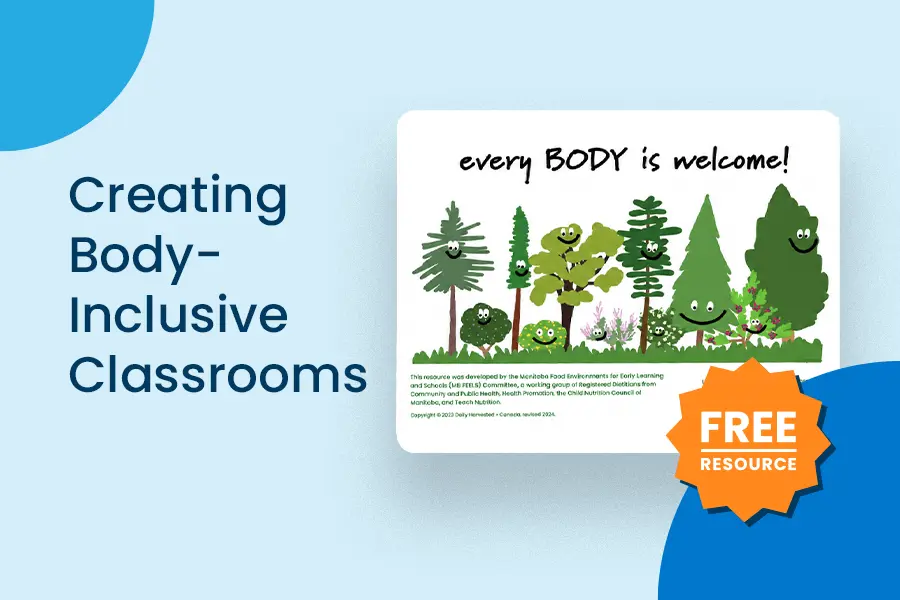
Every Body is Welcome Poster

This free poster is ideal for schools and early learning programs to foster kindness, belo[...]
Learn More