Copyright © 2026 Dairy Farmers of Canada. All rights reserved.

Are you in GeoProvince?

Your IP address says that you are in GeoProvince. This page is meant for residents of SiteProvince. We recommend you use GeoTitle instead.
Go to GeoTitle I wish to remain on SiteTitle

Science Highlights 

Use these points to explore science connections and explain the properties of ice cream.  


For kindergarten to Grade 6:   

  • Heat transfer and temperature changes 
    • Heat moves from warmer areas to colder ones. In this experiment, the cream mixture needs to lose heat before it can freeze. That is why the cream bag is surrounded by ice. 
    • Ice on its own is not cold enough to freeze the cream quickly. Adding salt lowers the temperature of the ice so that heat can transfer from the cream to the ice. This allows the cream mixture to freeze.  
    • Sugar lowers the freezing point of the cream mixture and helps keep the ice cream soft and scoopable.  
  • Ice cream texture 
    • Fat and sugar are needed to get creamy and smooth ice cream.  
    • Shaking the bag adds air to the cream mixture. Air bubbles form and are held in place by the fat. Constant shaking makes smaller air bubbles and helps prevent ice crystals from forming.  
    • If you didn’t shake the cream mixture, larger ice crystals would form. It would freeze into a solid block, more like an ice pop.  
  • Salt and winter safety 
    • This experiment shows how salt lowers the freezing temperature of water. This is why in some regions salt is spread on the roads and sidewalks in winter.  
    • Salt melts ice and prevents further freezing on roads and sidewalks, keeping us safe in winter.   
  • Brain freezes 
    • Have you ever eaten ice cream too fast and gotten a headache? Why does this happen?  
    • Your mouth and throat get very cold and your body wants to warm them up.  
    • Cold causes blood vessels to get smaller. Your body sends blood to the area to warm it up, causing blood vessels to get bigger.  
    • Sensitive nerves near the blood vessels notice the sudden change and send a message to your brain. This results in pain in your face and head.  
    • If you eat or drink something warm or press your tongue against the roof of your mouth, it will warm up your mouth and help relieve the pain.   


For Grades 7 to 12:  

  • Freezing point depression and heat transfer 
    • The freezing point of cream is about – 0.5 °C.  
    • Adding sugar to the cream lowers its freezing point.  
    • The temperature of the cream mixture needs to drop below the freezing point of water for the cream to become ice cream. Ice cubes alone are not cold enough. Adding salt to the ice causes freezing point depression of the water.  
    • The ice and salt mixture helps speed up heat transfer. Heat always moves from warmer to colder areas (higher to lower energy). The cream mixture is warmer, so heat transfers from the cream to the ice. This heat transfer changes the liquid cream to a solid. 
  • States of matter 
    • Matter exists in three states in most environments: solid, liquid, and gas.  
    • The ice changed from a solid to a liquid in this experiment. The surface of the ice cubes melted in the large bag.  
    • Water vapour changed from a gas to a liquid in this experiment. This resulted in condensation on the outside of the large bag.  
    • The condensation on the outside of the medium bag changed from a liquid to a solid. This layer of ice helped the cream mixture freeze to a solid.  
  • Agitation and thermal energy 
    • Quick and even heat transfer is needed to get creamy, smooth ice cream.  
    • Agitation helps heat transfer from the cream mixture to the ice water. This causes the cream to freeze more evenly and have smaller-sized ice crystals. Without shaking, large and uneven ice crystals would form, making the texture more like that of an ice pop.  
  • The role of each ingredient 
    • The cream contains fat which gives the ice cream flavour. The fat also provides structure to hold air bubbles as the ice cream freezes. This results in a smooth texture.  
    • Sugar is added for flavour. It also helps control the amount of ice formed during the freezing process, making a softer ice cream.  
    • Vanilla is added for flavour.  
  •   Commercial ice cream  
    • Did you notice a difference in the texture of your homemade ice cream compared to commercial ice cream?  
    • Ice cream bought at a store or dairy bar is made using a technology known as rapid freezing.  
    • The ice cream ingredients are mixed and chilled to 4 °C for less than 30 seconds. This produces a soft-serve ice cream with small ice crystals. The ice cream is put into tubs and placed in a hardening freezer at 30 °C for three hours.  
    • Your ice cream was made by shaking the cream mixture for 10 minutes in the bag. Compared to chilling it for 30 seconds, this longer freezing time created larger ice crystals and a different texture.  
    • Other ingredients are added to commercial ice cream recipes. Stabilizers and emulsifiers contribute to the smoother texture as well. 

Explore how dairy is produced in Canada 

  • The main ingredient in this recipe is cream, which comes from cow’s milk. Cream naturally floats to the top of fresh milk when it is collected at the farm. Before milk and cream are separated, fresh milk must be pasteurized to make sure it meets strict quality and safety standards. 
  • Milk comes from farms located across Canada. Watch the animated video The Curious Cook: Dairy Farm from Teach Nutrition to learn more.  

Explore all the STEM activities in this collection!

Grades K to 3

Grades 4 to 6

Grades 7 to 9

Grades 10 to 12

The Food Lab: Butter in a Jar

A hands-on STEM activity where learners make butter and buttermilk while exploring physica[...]
Learn More

Grades K to 3

Grades 4 to 6

Grades 7 to 9

Grades 10 to 12

The Food Lab: Food Dyes

A hands-on STEM activity where learners create natural dyes and compare how temperature af[...]
Learn More

Grades K to 3

Grades 4 to 6

Grades 7 to 9

Grades 10 to 12

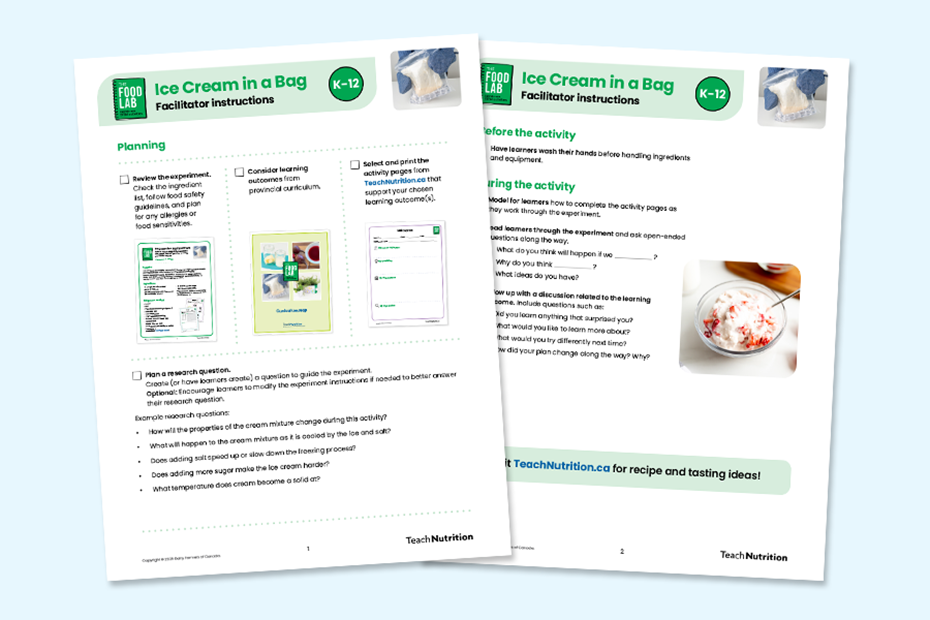
The Food Lab: Ice Cream in a Bag

A hands-on STEM activity where learners make ice cream while exploring temperature, moveme[...]
Learn More

Grades K to 3

Grades 4 to 6

Grades 7 to 9

Grades 10 to 12

The Food Lab: Milk Carton Garden

A hands-on STEM investigation where learners make an indoor garden using milk containers,[...]
Learn More