Copyright © 2026 Dairy Farmers of Canada. All rights reserved.

Are you in GeoProvince?

Your IP address says that you are in GeoProvince. This page is meant for residents of SiteProvince. We recommend you use GeoTitle instead.
Go to GeoTitle I wish to remain on SiteTitle

Tasting Ideas  

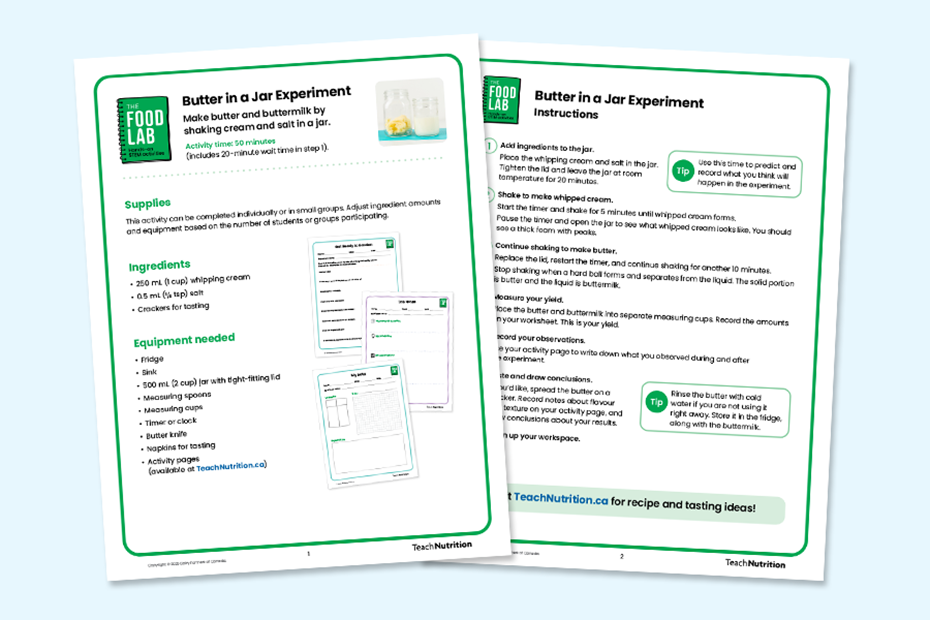
This experiment makes both butter and buttermilk. Here are ideas to use them, so nothing goes to waste.  

  • Add garlic to the butter. Brush it on bread or a pizza crust.   
  • Mix maple syrup with the butter. Spread it on pancakes or French toast.   
  • Add herbs like basil, dill or chives to the butter. These mixes make great spread options to use in the Bread Tasting Board 
  • Cool the buttermilk in the fridge. Invite students to sample it and describe its taste.  

Science Highlights 

Use these points to explain what happens as cream changes into butter and buttermilk. 


For kindergarten to Grade 6:  

  • When you start shaking, fat particles in the cream begin to stick together. This traps air bubbles and creates a foam called whipped cream. This phase doesn’t last long: more shaking causes the air bubbles to pop.  
  • The fat continues to separate as you keep shaking. It forms a solid ball, which is butter. The liquid is buttermilk.  
  • Note that this is a reversible, physical change and not a chemical change or reaction.   


For Grades 7 to 12:  

  • Agitation  
    • Cream contains tiny droplets of fat suspended in water. The fat molecules are encased in fat globules. Shaking the jar causes the fat globules in the cream to burst and release fat molecules into the liquid.  
    • The fat is hydrophobic and starts to separate from the liquid. The fat molecules begin to stick together and provide structure to the cream. This traps air bubbles and makes a foam called whipped cream. This phase occurs after five minutes and doesn’t last long: continued shaking causes the air bubbles to pop.  
    • The fat continues to separate from the liquid as you keep shaking. The fat molecules stick together tightly and form a solid ball, making butter denser than whipped cream. The solid is butter and the liquid is buttermilk.  

Explore how dairy is produced in Canada

  • Use The Curious Cook: Dairy Farm video to help learners explore where cream comes from and how dairy moves from farm to table. Canadian milk comes from farms located in all the provinces in Canada. Ask learners if they have seen a dairy farm in their community or province.  
  • Discuss how cream separates naturally from milk and why pasteurization is an important part of food safety.  

Explore all the STEM activities in this collection!

Grades K to 3

Grades 4 to 6

Grades 7 to 9

Grades 10 to 12

The Food Lab: Butter in a Jar

A hands-on STEM activity where learners make butter and buttermilk while exploring physica[...]
Learn More

Grades K to 3

Grades 4 to 6

Grades 7 to 9

Grades 10 to 12

The Food Lab: Food Dyes

A hands-on STEM activity where learners create natural dyes and compare how temperature af[...]
Learn More

Grades K to 3

Grades 4 to 6

Grades 7 to 9

Grades 10 to 12

The Food Lab: Ice Cream in a Bag

A hands-on STEM activity where learners make ice cream while exploring temperature, moveme[...]
Learn More

Grades K to 3

Grades 4 to 6

Grades 7 to 9

Grades 10 to 12

The Food Lab: Milk Carton Garden

A hands-on STEM investigation where learners make an indoor garden using milk containers,[...]
Learn More