Copyright © 2026 Dairy Farmers of Canada. All rights reserved.

Are you in GeoProvince?

Your IP address says that you are in GeoProvince. This page is meant for residents of SiteProvince. We recommend you use GeoTitle instead.
Go to GeoTitle I wish to remain on SiteTitle

Tasting Ideas

Here are ideas to use the foods from this experiment, so nothing goes to waste.   

  • Brainstorm how you could use the beets in a recipe. Try a simple beet salad topped with feta cheese or blend cooked beets with hummus. You can also chop cooked beets to use as part of the Kebab Creations recipe from Teach Nutrition!  

Science Highlights 

Use these points to explain why hot water resulted in dyes with a deeper colour.  


For kindergarten to Grade 6:  

  • Heat makes molecules move faster. The technical term for this is having more thermal energy.  
  • The dyes pair up with the molecules in the water and spread faster through the boiling water, making a deeper colour.  
  • Water molecules and food dyes move slower in cold water, resulting in dyes that are less intense.  
  • Note that this is a reversible, physical change and not a chemical change or reaction.  


For Grades 7 to 12:  

  • Thermal energy  
    • Food dye molecules move faster in hot water due to their increased thermal energy.  
    • This movement of molecules causes a higher rate of diffusion of dye into the water. The food dyes move from an area of high concentration within the food to an area of low concentration within the water.  
    • The food dye molecules mix easily with water molecules, making a more saturated dye.  
  • Extra variable  
    • Another factor to consider is the process of freezing fruit. Water inside the blueberry cell walls freezes and forms ice crystals, causing the cell walls to rupture. This means diffusion of food dyes occurs more easily with frozen blueberries compared to fresh blueberries.  
    • Diffusion of food dyes occurs more easily with frozen blueberries compared to fresh blueberries.  

Explore all the STEM activities in this collection!

Grades K to 3

Grades 4 to 6

Grades 7 to 9

Grades 10 to 12

The Food Lab: Butter in a Jar

A hands-on STEM activity where learners make butter and buttermilk while exploring physica[...]
Learn More

Grades K to 3

Grades 4 to 6

Grades 7 to 9

Grades 10 to 12

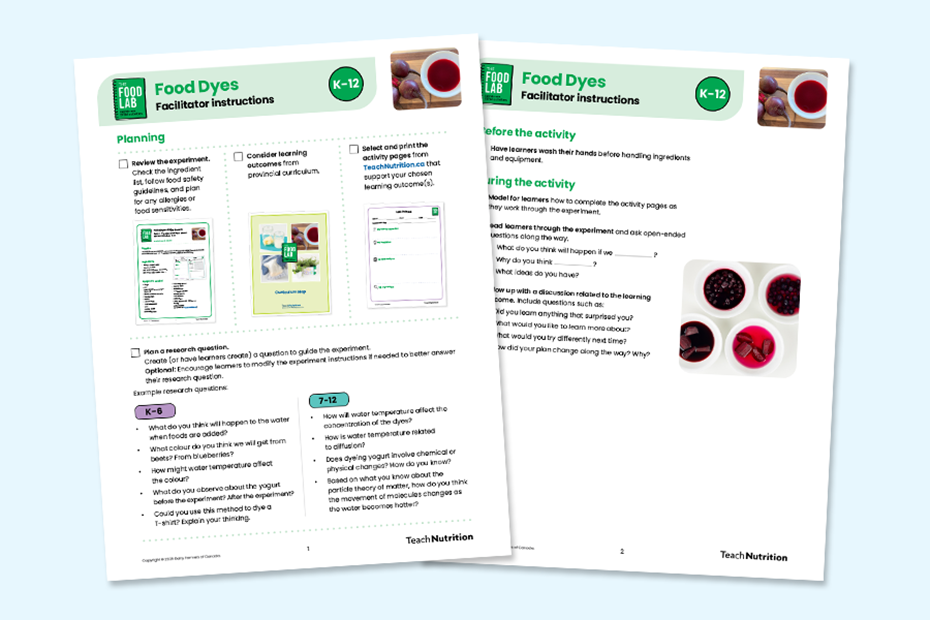
The Food Lab: Food Dyes

A hands-on STEM activity where learners create natural dyes and compare how temperature af[...]
Learn More

Grades K to 3

Grades 4 to 6

Grades 7 to 9

Grades 10 to 12

The Food Lab: Ice Cream in a Bag

A hands-on STEM activity where learners make ice cream while exploring temperature, moveme[...]
Learn More

Grades K to 3

Grades 4 to 6

Grades 7 to 9

Grades 10 to 12

The Food Lab: Milk Carton Garden

A hands-on STEM investigation where learners make an indoor garden using milk containers,[...]
Learn More